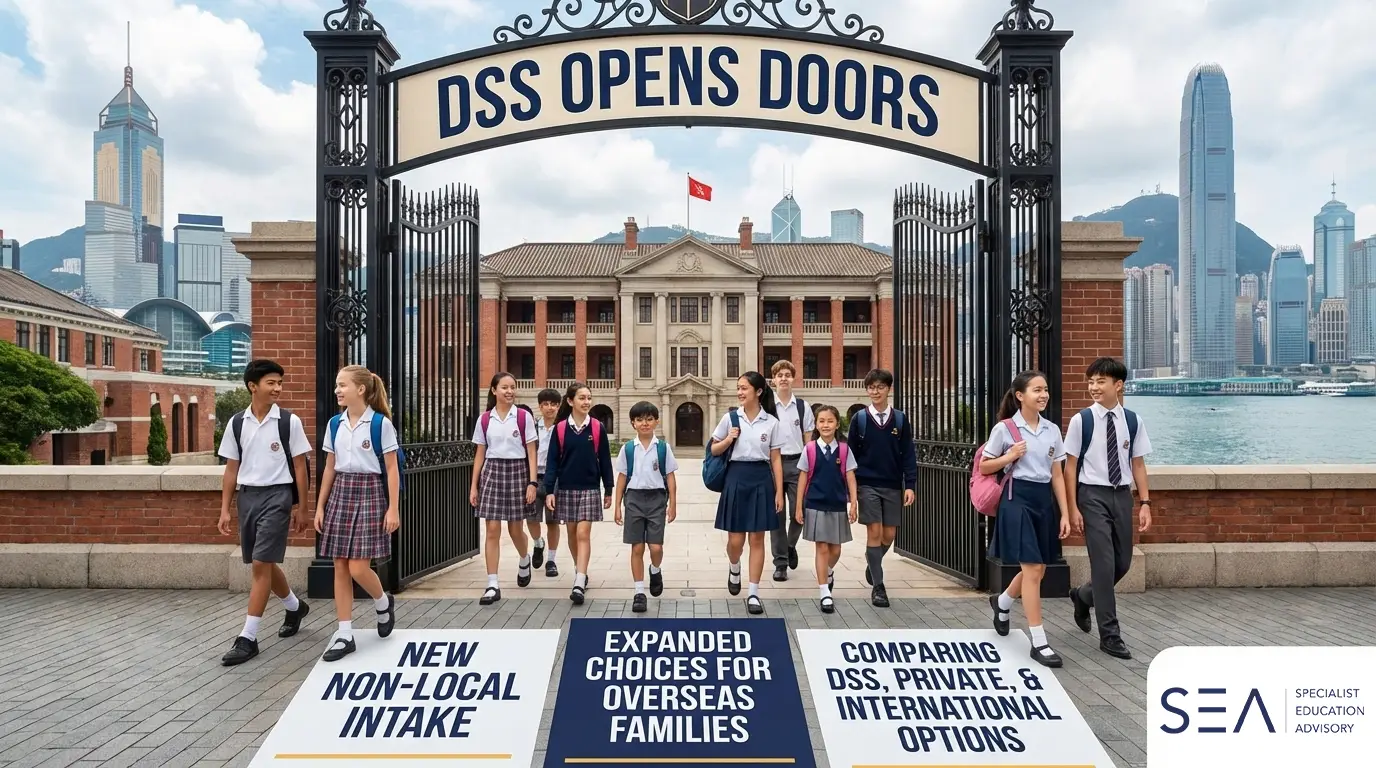
Raising non‑local quotas in Direct Subsidy Scheme (DSS) schools will mainly increase choice for overseas students and slightly intensify competition at secondary level, but the impact on most private and international schools is likely to be indirect rather than immediate.
What DSS schools are and what is changing
DSS schools are government‑subsidised but independently run schools that can charge fees and enjoy more flexibility in curriculum, admissions and resource use than traditional public schools.
Under a new trial initiative, over 40 of Hong Kong’s DSS schools have applied to expand class size and numbers so they can admit additional non‑local students on student visas, on a self‑financing basis.
Who the new places are targeting
The policy is designed to attract more non‑local pupils and support Hong Kong’s push to become an international education hub at basic education level, complementing recent expansions in non‑local university quotas.
These extra places are expected to appeal mainly to families from regions within Southeast Asia who are willing to pay fees and board, and whose children will study local or hybrid curricula like HKDSE or IB within a semi‑local environment who will eventually want to study university in Hong Kong.
Impact on private and international schools
The new DSS non‑local places are fee‑paying and often tied to boarding or student visa arrangements, they sit in a similar price bracket to some mid‑range international and private schools and may divert a segment of cost‑sensitive, academically focused families.
However, international schools still differentiate themselves through fully international curricula, higher proportions of non‑local students, and, in some cases, unique boarding offers (for example Harrow International School Hong Kong and Li Po Chun United World College), so direct competition will be strongest where families want both English‑medium and a recognised local pathway.
Opportunities and risks for families
For non‑local families, the DSS expansion opens up a new “third option” between local public schools and full international schools: English‑rich, exam‑strong environments with clearer routes into HKDSE or IB.
For local and expat parents, the main considerations will be class size, language mix, boarding expectations and whether a more local‑style environment with extra non‑local peers suits their child better than a traditional international school campus.
How SEA can help
SEA can help families compare DSS, private and international options side by side, looking at curriculum, language balance, fees, boarding, and university pathways in the context of this new DSS policy.
For parents considering Hong Kong as a study destination, SEA can also advise on school choices so that the increased DSS non‑local intake becomes a genuine opportunity rather than a source of confusion.
If you’re interested in learning more about SEA’s services, contact us for more information.
☎: 2569 5400
📲: 9174 7418
🔗: https://specialistedu.com.hk