
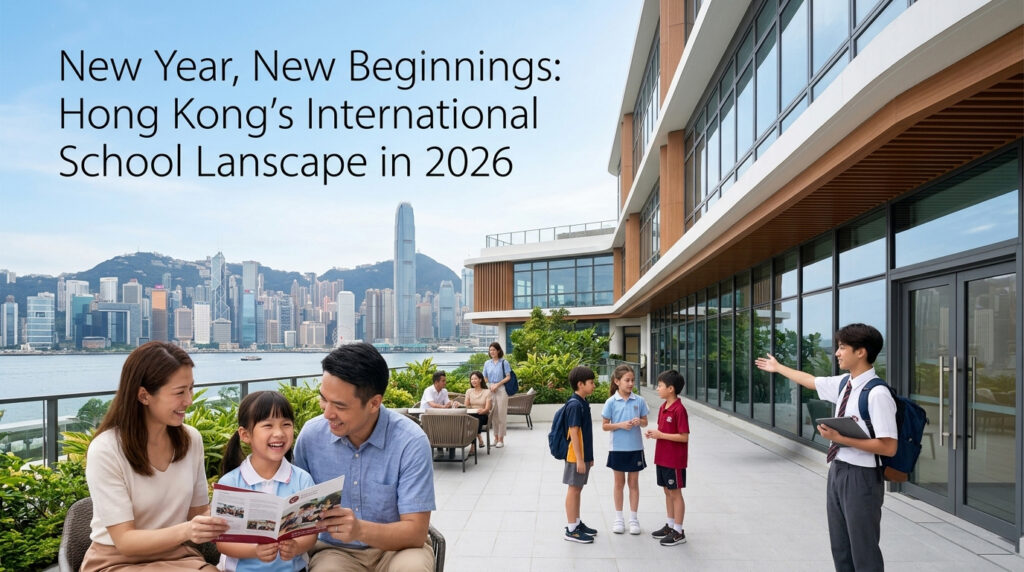
August and September mark the beginning of a new academic year. They are also a time of new beginnings, as students move into new year groups, families join new school communities, and new campuses open across Hong Kong.
The 2026–27 academic year has brought several notable developments, including the opening of new schools and kindergartens, the creation of purpose-built sixth-form centres, and changes in school leadership.
New schools and campuses
YK Pao School Hong Kong
YK Pao School Hong Kong welcomed its first students this year at its temporary Kowloon East campus in Yau Tong. The school offers a bilingual, dual-language education, with students learning in English and Putonghua. Its programme places a strong emphasis on Chinese language, literature, philosophy, history, customs, and festivals.
The school is initially offering Years 1 to 3, with plans for students to move into a purpose-built campus at Rose Street in Yau Yat Chuen in 2028. Its founding head is Mrs Cathy Braithwaite, who has extensive teaching experience in the United Kingdom and was formerly Head of Gresham’s Prep School.
New ESF kindergartens
The English Schools Foundation (ESF) has opened several new kindergartens for the 2026–27 academic year.
ESF Renaissance Kindergarten, located at Go Park in Sai Sha, provides 90 place. It offers children a custom-built early-years environment and a pathway into Renaissance College
ESF West Kowloon Kindergarten, located at The Long Beach in Kowloon, provides a pathway to ESF schools including Clearwater Bay School and Kennedy School.
On Hong Kong Island, ESF Quarry Bay Kindergarten has also opened in Kornhill. It is linked to Quarry Bay School and provides an early-years environment designed to support inquiry-based learning.
Parents should check the latest admissions policies directly as these are subject to change.
New sixth-form centres
Two schools have introduced new sixth-form facilities for their Y12 and Y13 students.
Kellett School has opened a purpose-built Sixth Form Centre in Kowloon Bay, directly connected to its main campus. The centre includes modern study areas, lecture theatres, examination rooms, higher-education counselling rooms, and social spaces.
Nord Anglia International School Hong Kong has established its Sixth Form Centre in Hung Hom. Facilities include science laboratories, a modern library, communal areas, flexible classrooms, and a fitness suite.
Dedicated sixth-form facilities can help create a more university-style environment and support students as they prepare for higher education.
Changes in school leadership
The new academic year has also brought several leadership changes:
- Mrs Cathy Braithwaite has become the Founding Head of YK Pao School Hong Kong
- The ISF Academy has welcomed back Dr Malcolm Pritchard as interim head
- Dr Wil Chan has taken on the interim leadership role at Canadian International School of Hong Kong following Dr Tim Kaiser’s retirement. Dr Chan previously led CDNIS’s kindergarten
- At German Swiss International School, Mr Ken Stevenson has become Acting Secondary School Principal for the International Section
What does this mean for families?
Leadership changes can understandably make parents concerned about stability. However, a change in head or senior staff does not automatically mean that a child’s education will be negatively affected. International schools regularly experience staff movement as educators take up positions in different countries and school systems.
The most important questions for parents are whether the school has a clear transition plan, strong teaching teams, effective pastoral care, and consistent communication with families.
Do Hong Kong families need more schools?
Hong Kong families now have a wider range of choices, including international, bilingual, private. New campuses can provide additional places and may be particularly helpful for families who face passport requirements or long waiting lists at established international schools.
Parents should note that schools offering international curricula are not all classified in the same way. Some private independent schools may not be subject to the same foreign-passport requirements as international schools officially recognised by the EDB.
This gives families more options, but it also makes the school-search process more complicated. Parents need to compare each school’s curriculum, language environment, admissions requirements, fees, location, progression arrangements, and long-term pathways.
At SEA, we help families understand the changing Hong Kong education landscape and identify schools that are realistic and suitable for their children. If you are looking for advice on international school admissions or are struggling to understand the system, contact us today to arrange a no-obligation 15-minute consultation.