
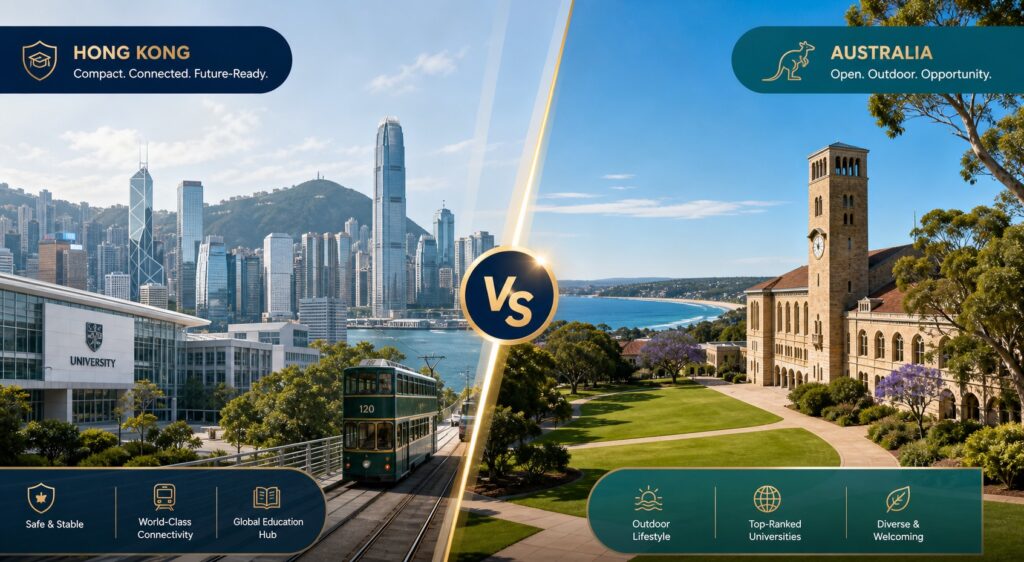
Hong Kong vs Australia: Which Study Destination Really Fits Your Child in 2026
Hong Kong now has multiple universities ranked in the global top 100, including the University of Hong Kong, Hong Kong University of Science and Technology (HKUST), Chinese University of Hong Kong (CUHK) andThe Hong Kong Polytechnic University (PolyU), making it a serious alternative to the United States for many families. The city is compact, highly connected and consistently rated as very safe, which reassures parents who want quality education with strong public transport, low campus crime and easy access to healthcare.
Day‑to‑day life is also linguistically flexible: English, Cantonese and Mandarin are widely used in universities, workplaces and daily life, which can make the transition smoother for students from across the border or international schools. For non‑local students, time spent in Hong Kong on a valid student visa can count towards the seven years of continuous ordinary residence required before applying for Permanent Residency, subject to meeting Hong Kong’s other conditions.
Hong Kong is especially compelling when you want:
- A highly ranked university degree in a safe, familiar Asian hub.
- A genuine mix of East‑meets‑West culture and language exposure.
- A potential seven‑year route to Permanent Residency while staying close to family.
Australia: outdoors lifestyle and layered PR pathways
Australia also has several universities in the global top 100, including the University of Melbourne, the University of Sydney, University of New South Wales (UNSW) and Australian National university (ANU) with many more in the top 200. Beyond rankings, Australia offers a very different lifestyle: open campuses, beaches and national parks, and a more laid‑back, outdoors‑focused culture that many students find attractive.
English is the main language, but there are well‑established Chinese communities in cities like Sydney, Melbourne and Brisbane, which can provide cultural comfort while students integrate into local life. For most international students, the PR journey is multi‑step: student visa → Temporary Graduate visa → skilled or employer‑sponsored visa, usually based on age, English, qualifications and occupation.
Hong Kong passport holders and eligible BNO holders have an additional “Hong Kong stream” pathway that can make this process easier: after completing an eligible 2‑year diploma or higher degree in Australia, they can obtain a longer Temporary Graduate visa and then apply for 189/191 Permanent Residency under specific Hong Kong‑linked subclasses, with full work rights on the graduate and Permanent Residency (PR) stages. Students in this stream are still subject to standard student‑visa work limits (currently 40 hours per fortnight) while studying, then move to full‑time work rights on the graduate visa and subsequent Permanent Residency (PR) visas.
Australia is particularly attractive when you want:
- A more relaxed, outdoors‑oriented lifestyle and culture.
- Strong university and vocational options, including trades and applied professions.
- A structured, if longer, pathway from study to PR – especially if you qualify for Hong Kong stream concessions.
Cost and value: where each can come out ahead
Tuition at Hong Kong’s top universities is often on par with, and in some cases lower than, fees at comparable US institutions, especially when you factor in living costs and the ability to live at home or with relatives. In Australia, international fees vary widely by university and course, but for many families total costs (tuition plus living) can be more competitive than a US degree, particularly outside the most expensive cities.
If your priority is a relatively affordable, safe, high‑ranked degree close to home, Hong Kong often comes out ahead. If you want your child to combine academic study with lifestyle, English immersion and potential migration outcomes, Australia can deliver strong long‑term value, especially for Hong Kong citizens and BNO holders on the dedicated stream.
When Hong Kong “wins”
Hong Kong is likely the better fit when you are looking for:
- Affordable quality in a safe city – world‑class universities and strong public safety without US‑level price tags.
- Top‑100 rankings within Asia – multiple Hong Kong universities firmly in the global and regional top tiers.
- A true East‑meets‑West hub – trilingual environment, dense business networks and proximity to mainland China.
When Australia “wins”
Australia may be the smarter choice when you prioritise:
- The great outdoors and lifestyle – beaches, space, campus life and a more relaxed everyday culture.
- Top‑ranked universities plus colleges – strong showing in the global top 100 and respected vocational education and training (TAFE) feeding into trade and applied careers.
- Clear vocational and trade pathways – for students targeting occupations like electricians, plumbers or other trades, Australia’s vocational system and skills‑shortage list can create strong post‑study work and PR opportunities.
If you are weighing Hong Kong versus Australia for your child, SEA can walk you through rankings, costs, language and visa/PR pathways for your specific situation. Contact SEA’s Education Advisor Jessica Yuen to arrange a free 15‑minute, no‑obligation call here.